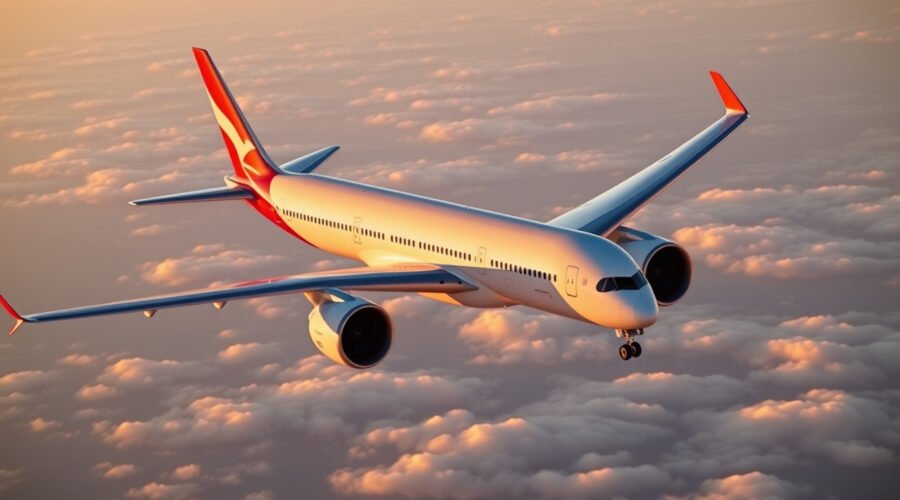
The Qantas 12 A350 order can look surprisingly small beside airline deals that run into the dozens or hundreds. But Project Sunrise is not a normal fleet expansion. Qantas ordered 12 specially configured Airbus A350-1000ULRs for a narrow job: opening ultra-long-haul routes that few aircraft can operate economically.
Quick Answer
Qantas ordered 12 A350-1000ULRs because Project Sunrise is a specialized ultra-long-haul program, not a general fleet replacement. Qantas now says six aircraft will support new point-to-point ultra-long-haul flying and six will support wider network diversification, while all 12 contribute to freight growth. Deliveries are planned from 2027 to 2030.
Last checked: September 30, 2026. Dates and figures were verified against official sources.
Key Takeaways
- Sydney–London is scheduled to begin as a daily nonstop service in October 2027; Sydney–New York is planned for mid-2028.
- The A350-1000ULR uses an additional 20,000-litre rear centre fuel tank and is designed for flights of more than 16,000 kilometres and up to 22 hours.
- Each Project Sunrise aircraft has 238 seats: 6 First, 52 Business, 40 Premium Economy and 140 Economy seats.
- Qantas’ 2026 investor plan assigns six aircraft to new ultra-long-haul flying and six to broader network diversification.
- The 12 Project Sunrise aircraft are separate from another 12 A350-1000LRs Qantas plans to add for its wider long-haul network.
🛫 Why Qantas ordered only 12 A350s
The number makes more sense once you separate Project Sunrise from the rest of Qantas’ fleet renewal. These 12 aircraft are a purpose-built A350-1000ULR subfleet, rather than the airline’s only future A350s.
Qantas’ current Project Sunrise fleet information confirms that it ordered 12 A350-1000ULRs in May 2022. The airline also plans to receive another 12 A350-1000LR aircraft from financial year 2028 for its broader international network.
That distinction changes the story. Qantas is not trying to serve its entire long-haul network with 12 aircraft. It is creating a specialized fleet for routes where range, passenger comfort, premium demand and nonstop travel time matter more than sheer capacity.
Australia’s geography explains much of the need. Project Sunrise flights will connect the east coast of Australia directly with cities that normally require a stop, putting some sectors beyond 16,000 kilometres and close to the practical limit of current passenger-aircraft endurance.
The fleet size therefore reflects the mission. It does not represent the full scale of Qantas’ international fleet plan.
🌅 Project Sunrise explains the entire order
Project Sunrise is Qantas’ plan to connect Australia’s east coast directly with major distant cities. Sydney–London and Sydney–New York are the first two confirmed routes.
The aircraft is not simply a standard A350-1000 with fewer seats. Airbus created the A350-1000ULR configuration around the mission, including an additional rear centre fuel tank and related fuel-system changes.
Airbus says the first A350-1000ULR test aircraft completed its maiden flight on June 2, 2026. Its A350-1000ULR flight-test announcement says the aircraft is designed for sectors of almost 10,000 nautical miles and flight times of up to 22 hours.
The rear centre tank increases the aircraft’s range by about 1,000 nautical miles. The certification program also covers the modified fuel system, cabin ventilation and temperature control, and a new galley cooling system intended for very long flights.
| Milestone | Confirmed timing |
|---|---|
| Project Sunrise announced | 2017 |
| A350-1000 selected as preferred aircraft | December 2019 |
| 12 A350-1000ULRs ordered | May 2022 |
| First A350-1000ULR test flight | June 2026 |
| First aircraft due to Qantas | April 2027 |
| Sydney–London nonstop launch | October 2027 |
| Sydney–New York nonstop launch | Mid-2028 |
| Sunrise fleet delivery period | 2027–2030 |
That timeline shows why Project Sunrise is better viewed as a dedicated network program than as an ordinary aircraft purchase.
💰 Why a 12-aircraft fleet can still have a large financial impact
Qantas now gives a more detailed explanation of what those 12 aircraft are intended to do. Its own investor material divides the fleet into two broad strategic groups instead of assigning every aircraft only to London or New York.
In its August 2026 Qantas International Investor Update, the airline shows six A350-1000ULRs supporting new point-to-point ultra-long-haul flying. Another six support network diversification in combination with redeployed Boeing 787-9s.
All 12 are also part of Qantas’ plan to increase freight capacity through network changes. That is a much more precise explanation than saying the aircraft are simply for two headline routes.
| Qantas’ 2026 plan | Role |
|---|---|
| 6 aircraft | New point-to-point ultra-long-haul flying |
| 6 aircraft | Network diversification using the A350-1000ULR and redeployed 787-9 capacity |
| All aircraft | Freight-growth opportunities linked to network optimization |
Qantas says the Sunrise program should add about 14 billion available seat kilometres at scale. It also forecasts roughly A$400 million in annual EBIT uplift once the program reaches scale.
Those are company forecasts, not guaranteed outcomes. They show, however, that Qantas does not measure the value of the order by aircraft count alone.
The small subfleet also limits how much capital enters service at once. Deliveries are spread from 2027 through 2030, allowing the airline to build routes, crews and supporting infrastructure in stages.
✈️ Why Qantas chose the A350 instead of Boeing’s 777X
Airbus and Boeing both competed for Project Sunrise, with Boeing’s 777X proposal centered on the 777-8. Qantas ultimately selected the A350-1000 as its preferred aircraft in December 2019, then placed the formal order in 2022.
What Qantas actually said about the aircraft decision
The original selection is often simplified into a story about Boeing certification delays. Qantas’ own public material gives a more careful picture.
Its February 2020 investor update says the A350-1000 had been selected as the preferred Project Sunrise aircraft after evaluation. It also says the project still had to clear strict business-case and regulatory hurdles.
Contemporary Qantas material highlighted the Rolls-Royce Trent XWB engine’s reliability record and Airbus’ ability to modify the A350-1000 with extra fuel capacity and increased performance for the mission.
That is stronger evidence than claiming one certification issue alone decided the contest. Qantas evaluated the complete aircraft, engine, performance, delivery and commercial package.
The A350 already had real ultra-long-haul experience
The A350 family also entered the contest with operational experience on very long routes. Singapore Airlines, for example, continues to operate nonstop Singapore–New York service using the A350 family.
That does not mean Singapore’s operation is identical to Project Sunrise. Qantas requires the larger A350-1000ULR, a new rear centre tank and a different cabin configuration to meet its own range and payload goals.
It does show that the A350 platform already had extensive long-haul service behind it before Qantas’ specialized variant reached flight testing.
🛋️ What the 12 A350s mean for passengers
A flight that can remain airborne for up to 22 hours needs a different cabin strategy from a normal long-haul service. Qantas has therefore traded seat density for space, premium seating and features designed around rest and movement.
The Project Sunrise A350-1000ULR seats 238 passengers across four cabins. Qantas says this is the lowest seat density of any A350-1000 in service.
| Cabin | Seats | Key detail |
|---|---|---|
| First | 6 | Enclosed suites with a separate seat and flat bed |
| Business | 52 | Suites with sliding privacy doors and direct aisle access |
| Premium Economy | 40 | 2-4-2 layout with redesigned head, leg and calf support |
| Economy | 140 | Includes 42 Economy Plus seats with 34-inch pitch |
The Wellbeing Zone is designed for movement
The dedicated Wellbeing Zone sits between Premium Economy and Economy, not at the rear of the aircraft. It includes stretch handles, guided movement content, a hydration station and refreshments.
Qantas developed the wider cabin concept with researchers from the University of Sydney’s Charles Perkins Centre. The university’s Project Sunrise research summary describes work on lighting, food timing and physical movement aimed at reducing the effects of jet lag.
Lighting and cabin pressure also matter
Qantas has developed 12 cabin-lighting scenes designed around sleep, wakefulness and adjustment to the destination time zone. The inflight entertainment system also shows meal and rest periods so passengers can plan around the flight schedule.
Cabin pressure is another A350 advantage. Airbus says the A350 maintains an average cabin altitude of about 6,000 feet, alongside adjustable ambient lighting and zone-based temperature control.
No cabin feature can make a 20-hour flight feel short. The design instead aims to reduce some of the strain that comes from spending almost a full day inside one aircraft.
🌍 Where the 12 Project Sunrise aircraft will fly
Only two Project Sunrise destinations are currently confirmed: London and New York from Sydney. Older speculation about Frankfurt, Chicago or other specific city pairs should not be treated as an announced Qantas schedule.
Sydney to London starts first
Qantas says daily Sydney–London nonstop flights are scheduled to begin in October 2027. Tickets are due to go on sale in February 2027.
The airline’s June 2026 Project Sunrise launch announcement says the new service will cut up to four hours from the travel time of current one-stop options.
The new flight will operate alongside Qantas’ existing Perth–London nonstop service and Sydney–Singapore–London service. Project Sunrise is therefore adding a new option rather than eliminating the airline’s existing connection models.
Sydney to New York follows in 2028
Sydney–New York is now scheduled to begin in mid-2028, with tickets planned to go on sale in August 2027. It will connect the two cities nonstop for the first time.
Qantas has said Project Sunrise will eventually reach additional destinations from Australia’s east coast. It has not yet announced specific next cities beyond London and New York.
The wider opportunity is broader than two routes
Qantas’ 2026 investor presentation maps longer-term opportunities across Europe, North America, South Africa and South America. It does not name a firm schedule for additional Sunrise cities.
That distinction matters. The 12-aircraft fleet has broader network value, but readers should separate an identified market opportunity from an officially announced route.
📣 Why Project Sunrise is also a brand and network strategy
Project Sunrise gives Qantas something that is difficult to copy with advertising alone: a distinctive product built around Australia’s distance from Europe and North America. The nonstop proposition can become part of the airline’s identity if customers value the time saved.
The commercial advantage is not simply avoiding another airline’s hub. Qantas can keep more of the journey inside its own network while offering passengers a direct itinerary that did not previously exist from Sydney to London or New York.
That also gives Qantas more control over the passenger experience. A traveler does not need to change aircraft, collect themselves during a transit stop or depend on a second departure staying on schedule.
The cabin reinforces the same positioning. More than 40% of the A350’s seats are in First, Business or Premium Economy, while the aircraft still carries 140 Economy passengers.
In other words, the aircraft and the route strategy support each other. Qantas is not just buying range. It is building a premium-heavy nonstop product around that range.
⚠️ The real risks behind a 12-aircraft ultra-long-haul fleet
The plan still carries meaningful risk. Ultra-long-haul flying places aircraft, crews and economics under more pressure than shorter international operations.
1. Premium demand has to remain strong
Qantas’ financial case assumes strong revenue quality from a premium-heavy cabin and demand for nonstop flying. That makes customer willingness to pay for convenience a central part of the business case.
The airline’s A$400 million annual EBIT-uplift figure is a forecast for the program at scale. Fuel prices, fares, competition and passenger demand can all change the result.
2. Aircraft utilization and disruptions matter more
An aircraft flying for roughly 19 to 22 hours spends a large part of each operating day on one sector. Delays, maintenance problems or diversions can therefore consume a significant amount of scarce fleet time.
A 12-aircraft fleet also provides less spare capacity than a large global subfleet. Qantas will need careful scheduling and recovery planning as more Sunrise aircraft enter service.
3. Crew planning is unusually demanding
Flights this long require additional operating and rest considerations for pilots and cabin crew. Qantas said in 2026 that more than 360 pilots and 1,200 cabin crew would be trained by the time the 12th Sunrise aircraft arrives.
That training program includes A350 simulator work and operational preparation with other experienced A350 operators.
4. Certification and delivery remain dependencies
The A350-1000ULR includes changes that require certification before commercial service. Airbus has flight-tested the new fuel system, rear centre tank and other modified systems.
Qantas also states that aircraft delivery, ticket sales and service commencement remain subject to regulatory approvals and aircraft certification. That means announced dates are firm plans, but not unconditional guarantees.
5. Competitors already understand ultra-long-haul flying
Qantas will not operate in a market with no experience behind it. Singapore Airlines already runs ultra-long-haul A350 services, while other airlines continue to develop longer point-to-point networks.
The competitive advantage is therefore the specific nonstop Australia–London and Australia–New York proposition, not an exclusive claim to ultra-long-haul aviation itself.
🔮 What the Qantas A350 order says about long-haul aviation
The 12-aircraft order shows how new-generation widebodies can create routes without replacing the hub-and-spoke model entirely. Airlines can use specialized aircraft to connect high-value city pairs directly while still relying on hubs for destinations that cannot support nonstop service.
That is what Qantas appears to be doing. Sydney–London and Sydney–New York will sit beside existing connecting and nonstop services rather than replacing every one-stop itinerary.
The economics also depend on matching aircraft to routes. Qantas’ own investor language describes a “right aircraft, right route” strategy, with the A350-1000ULR opening new markets while 787-9 aircraft can move to other parts of the network.
This is also why the number 12 should not be read in isolation. Six aircraft are planned around new point-to-point ultra-long-haul flying, while six support broader network diversification. Separate A350-1000LR orders extend the A350 strategy beyond Sunrise.
If the scheduled launches proceed, the measure of success will not be whether 12 sounds large beside another airline’s order. It will be whether those aircraft can deliver the route economics, premium demand, reliability and network flexibility Qantas has built its business case around.

Frequently Asked Questions
Why is Qantas only buying 12 A350-1000ULRs?
Qantas designed the 12-aircraft fleet around Project Sunrise and related network changes rather than a full long-haul fleet replacement. Its 2026 investor plan assigns six aircraft to new point-to-point ultra-long-haul flying and six to broader network diversification, with all 12 also supporting freight growth.
What is Project Sunrise?
Project Sunrise is Qantas’ program for nonstop ultra-long-haul flights from Australia’s east coast to distant global cities. Sydney–London and Sydney–New York are the first confirmed routes, using specially modified Airbus A350-1000ULRs capable of flying for up to 22 hours.
When will Qantas start nonstop Sydney–London flights?
Qantas plans to begin daily nonstop Sydney–London Project Sunrise services in October 2027. Tickets are scheduled to go on sale in February 2027, although Qantas notes that service commencement remains subject to required aircraft certification and regulatory approvals.
When will Qantas fly nonstop from Sydney to New York?
Qantas plans to launch nonstop Sydney–New York flights in mid-2028. Tickets are scheduled to go on sale in August 2027, making New York the second confirmed Project Sunrise destination after the Sydney–London service begins.
What is different about the Qantas A350-1000ULR?
The Qantas A350-1000ULR has an additional rear centre fuel tank and associated system changes for ultra-long-range flying. It also uses a low-density 238-seat cabin with four classes, custom lighting and a dedicated Wellbeing Zone for stretching, hydration and movement.
Why did Qantas choose the Airbus A350 instead of the Boeing 777X?
Qantas selected the A350-1000 as its preferred Project Sunrise aircraft after evaluating Airbus and Boeing proposals. Its public material highlighted the A350’s mission capability, the Trent XWB engine’s service record and Airbus’ ability to provide the fuel and performance changes required for Sunrise.
How many passengers will a Qantas Project Sunrise A350 carry?
Each Qantas A350-1000ULR is configured for 238 passengers. The cabin has six First suites, 52 Business suites, 40 Premium Economy seats and 140 Economy seats, including 42 Economy Plus seats with additional pitch and priority benefits.
Are Frankfurt, Chicago or Dallas confirmed Project Sunrise routes?
No. As of September 2026, Qantas has confirmed Sydney–London and Sydney–New York as the first Project Sunrise routes. Qantas has identified broader opportunities across regions including Europe and North America, but it has not announced Frankfurt, Chicago or Dallas as additional Sunrise services.
Sources
- Qantas Airbus A350 Project Sunrise: Current aircraft orders, delivery timing, route launch dates and cabin specifications.
- Airbus A350-1000ULR first-flight announcement: Flight-test status, rear centre tank, range changes, certification work and 22-hour capability.
- Qantas International Investor Update, August 2026: 12-aircraft allocation, delivery period, network strategy and expected financial contribution.
- Qantas 2020 investor update: A350-1000 selection and Project Sunrise business-case requirements.
- Qantas Project Sunrise launch announcement: Sydney–London timing, 20,000-litre fuel tank, training and route strategy.
- University of Sydney Charles Perkins Centre: Research on lighting, meals, movement and jet-lag mitigation for Project Sunrise.
- Airbus A350 long-range cabin overview: Cabin altitude, lighting and long-haul passenger-comfort features.
- Singapore Airlines Singapore–New York service: Current A350-family ultra-long-haul nonstop operation.