Pompeii and Herculaneum are two of the world’s most important Roman archaeological sites. Both stood near Mount Vesuvius in Campania, Italy, and both were destroyed during the eruption of AD 79. Yet they were buried in different ways, so they preserve different parts of Roman life. Pompeii gives you the scale and street plan of a large ancient town, while Herculaneum is smaller and preserves extraordinary details such as upper floors, wooden objects, food remains, and papyrus scrolls.
Quick Answer
The main difference between Pompeii and Herculaneum is scale versus preservation. Pompeii is much larger and better for understanding the layout of a Roman city. Herculaneum is more compact but preserves more upper floors, carbonized wood, furniture, food, and other organic materials because of the way volcanic flows buried the town.
Key Takeaways
- Pompeii and Herculaneum were flourishing Roman communities destroyed by the eruption of Mount Vesuvius in AD 79.
- Pompeii is much larger and preserves an unusually complete urban landscape of streets, houses, shops, temples, baths, theaters, and an amphitheater.
- Herculaneum is smaller but often preserves buildings in greater vertical and material detail, including upper stories and carbonized wood.
- The first systematic Bourbon excavations at Herculaneum began in 1738; official excavation at Pompeii followed in 1748.
- Herculaneum had wealthy homes and elite residents, but it was not simply an exclusive resort populated only by the rich.
- Pompeii is usually the stronger choice for visitors who want scale and famous monuments; Herculaneum suits visitors who want a shorter, more detailed look at Roman domestic life.
- Visiting both gives the fullest picture because the two sites preserve complementary evidence.
Pompeii vs Herculaneum: Main Differences
| Comparison | Pompeii | Herculaneum |
| Overall experience | A vast Roman urban landscape | A compact site with exceptional architectural detail |
| Excavated area | UNESCO describes about 44 hectares of excavated urban remains | Only a relatively small portion of the ancient town is open; much remains below modern Ercolano |
| Preservation strength | Street plan, public monuments, houses, wall paintings, mosaics, casts | Upper floors, carbonized timber, furniture, food, wax tablets, papyri |
| Famous sights | Forum, amphitheater, theaters, baths, House of the Vettii, Villa of the Mysteries | Suburban Baths, House of Neptune and Amphitrite, College of the Augustales, ancient shoreline, Villa of the Papyri |
| Best for | Scale, urban history, famous monuments, longer visits | Fine details, preserved houses, shorter visits |
Note: Calling Herculaneum “better preserved” does not mean that it is automatically the better archaeological site. Pompeii preserves a far larger urban landscape, while Herculaneum preserves certain buildings and organic materials in exceptional detail.
Historical Significance of Pompeii and Herculaneum
The historical importance of Pompeii and Herculaneum extends far beyond the disaster that destroyed them. Together they preserve an unusually detailed picture of Roman society, architecture, religion, commerce, housing, food, art, engineering, and everyday behavior during the first century AD.
UNESCO recognizes Pompeii, Herculaneum, and the associated villas at Torre Annunziata as a World Heritage property because they preserve Roman urban and suburban life with exceptional completeness.
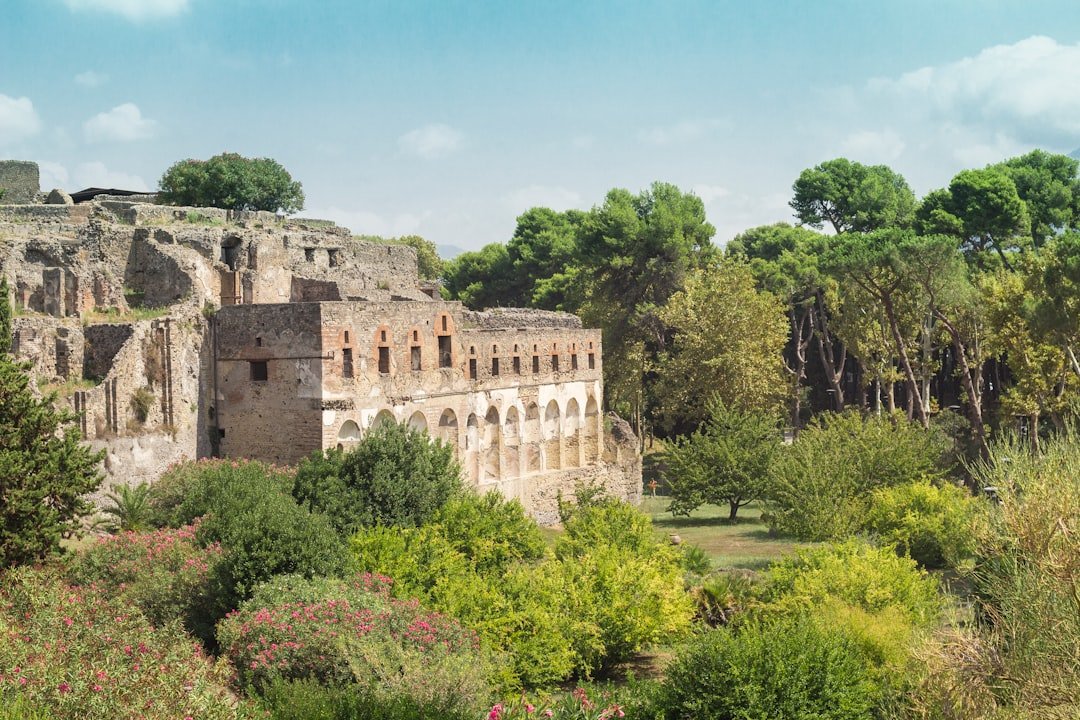
Pompeii was a substantial commercial town. Its surviving streets contain shops, workshops, houses, public baths, temples, administrative buildings, theaters, an amphitheater, and extensive graffiti and painted inscriptions. These remains allow researchers to examine both formal civic life and the ordinary activities of residents.
Herculaneum was smaller. It occupied a coastal plateau and contained luxurious residences, shops, baths, religious buildings, and other public facilities. Some of its houses clearly belonged to prosperous members of the municipal elite, but archaeological evidence also records a broader population. At the ancient shoreline, for example, victims found together included men and women, young and old, and people of different social status.
The contrast is therefore more useful when framed as large commercial town versus smaller coastal town rather than ordinary Pompeii versus exclusively aristocratic Herculaneum.
Archaeological Discoveries in Pompeii and Herculaneum
Systematic excavation of the two sites began during the Bourbon period in the eighteenth century, but Herculaneum came first. According to the Archaeological Park of Herculaneum, systematic underground exploration began in 1738. Official excavation at Pompeii began ten years later, in 1748.
The early work at Herculaneum was difficult because the ancient city lay beneath deep, hardened volcanic deposits and the modern settlement above it. Excavators reached ancient structures through shafts and tunnels. Much of ancient Herculaneum still remains buried beneath modern Ercolano.
Pompeii eventually allowed much broader open-air excavation. Its houses, streets, shops, baths, temples, entertainment buildings, and civic spaces revealed the physical organization of a Roman town on an extraordinary scale.
One of Pompeii’s best-known discoveries is the Villa of the Mysteries. Its famous continuous wall painting is associated with Dionysus and a mysterious ritual scene. The House of the Vettii is another major example, preserving richly decorated rooms and paintings connected with mythology, religion, work, status, and domestic life.
Herculaneum has produced equally important but different evidence. The Villa of the Papyri contained more than 1,800 charred papyrus scrolls from an ancient library. Because the rolls are extremely fragile, researchers have increasingly relied on non-destructive imaging and digital techniques to study them.
The ancient shoreline produced another remarkable discovery. Beginning in 1980, archaeologists uncovered roughly 300 human skeletons in vaulted spaces near the beach. Their belongings and physical remains provide valuable evidence about people who attempted to escape the eruption.
Comparison of Urban Planning and Layout
Pompeii and Herculaneum both show organized urban planning, so it is misleading to describe Pompeii as a rigid grid and Herculaneum as a town of mainly winding streets.
Pompeii’s much larger excavated area makes its street network easier for modern visitors to understand. Streets divide the town into blocks or insulae, with houses, shops, workshops, public buildings, religious spaces, and entertainment venues distributed across the urban landscape. The Forum formed a major civic and religious center, while other districts contained baths, theaters, the amphitheater, markets, and residential properties.
Herculaneum also had a planned street system. The official archaeological park describes streets organized around decumani and cardini, the principal east-west and north-south routes typical of many ancient Italian towns. Its smaller excavated area includes residential and commercial blocks as well as baths, a palaestra, religious buildings, and other public spaces.
What makes the two sites feel different today is therefore not simply their original street geometry. Pompeii exposes a much broader cityscape. Herculaneum presents a smaller excavated zone in which multi-story houses, terraces, shops, decorative schemes, and domestic structures can often be examined at closer range.
Differences in Architecture and Building Materials
Both Pompeii and Herculaneum contain architecture from different periods of their long histories. Builders used combinations of local stone, volcanic materials, mortar, Roman concrete, brick or brick-facing, timber, plaster, stucco, marble, and decorative stone depending on the period, building, and owner’s resources.
Pompeii’s scale gives visitors a particularly broad view of Roman architecture. The city contains monumental public buildings, temples, baths, theaters, an amphitheater, shops, modest houses, and large elite residences. Its houses also show how domestic plans changed over time. Wealthy domus could include atria, peristyle gardens, dining rooms, fountains, decorative floors, and elaborate wall paintings.
Herculaneum’s great architectural advantage is preservation. Hot volcanic deposits carbonized and sealed many organic components that would normally disappear. As a result, visitors can encounter surviving wooden structural elements, doors, furniture, staircases, upper floors, and other details that make some buildings feel unusually complete.
This does not mean that every Herculaneum building was more luxurious than its Pompeian counterpart. Pompeii also contained extremely wealthy houses. The safer comparison is that Herculaneum preserves more of certain architectural materials, while Pompeii preserves a much larger sample of an ancient urban environment.
Comparison of Art and Artifacts
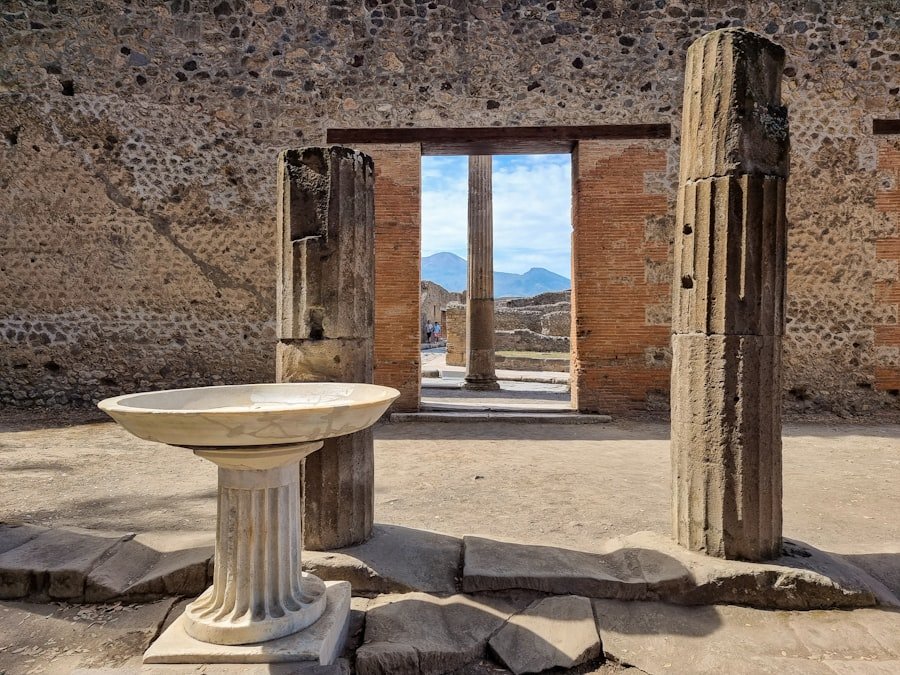
Everyday Life and Mythology in Pompeii
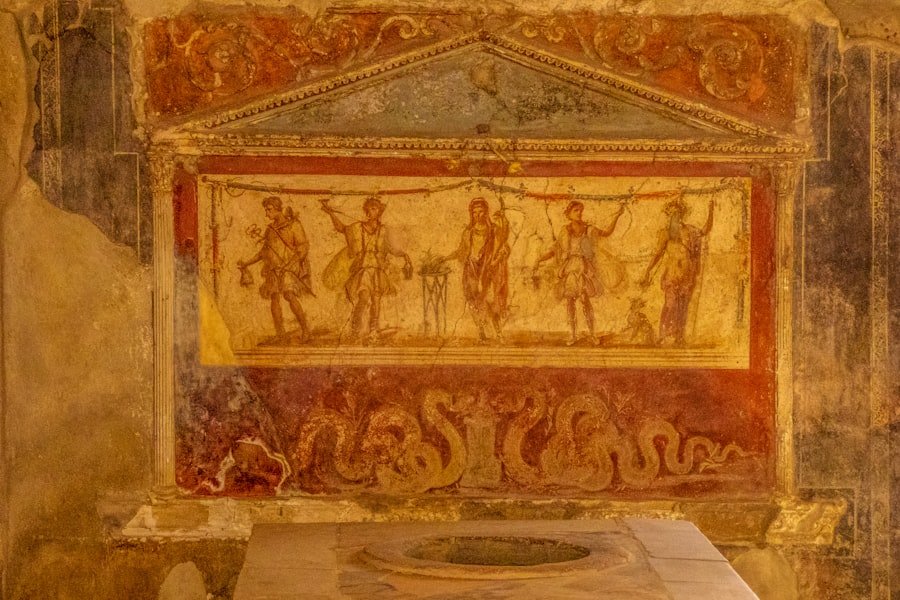
Pompeii preserves an enormous range of wall paintings, mosaics, graffiti, inscriptions, household equipment, religious objects, sculptures, commercial tools, and personal belongings.
The House of the Vettii is particularly famous for its richly decorated rooms. Its paintings include mythological subjects, religious imagery, and a celebrated frieze of Cupids performing activities associated with trades and production. Such material connects elite display with the commercial world that supported Roman urban life.
The Villa of the Mysteries offers a different type of artistic experience. A large fresco extending across three walls depicts a scene connected with Dionysus and ritual activity, although scholars continue to discuss exactly how individual figures and actions should be interpreted.
Art and Decoration in Herculaneum
Herculaneum also preserves exceptional wall paintings, mosaics, sculpture, and architectural decoration. The House of Neptune and Amphitrite, for example, is known for its colorful glass-paste wall mosaic and richly decorated fountain area.
The site’s preservation makes it especially useful for understanding how art functioned within complete rooms and multi-story houses. Decorative surfaces can be studied alongside surviving doors, wooden features, furniture, storage areas, shops, water installations, and household objects.
Artifacts and Craftsmanship
It is not useful to rank one city’s artifacts as generally better crafted than the other’s. Both communities produced and used objects ranging from inexpensive everyday goods to luxury possessions.
The major difference is the archaeological record that survived. Pompeii provides vast quantities of pottery, inscriptions, tools, mosaics, frescoes, sculpture, household objects, and casts. Herculaneum adds unusually well-preserved organic materials such as carbonized wood and food, along with wax tablets and the papyrus library from the Villa of the Papyri.
Together, these finds show Roman life across a much wider range of materials than either site could provide alone.
Cultural and Social Differences
Pompeii’s large excavated area makes social diversity highly visible. Archaeologists can study elite houses beside smaller residences, workshops, food businesses, public baths, religious sites, entertainment venues, and streets covered with political and personal messages.
Merchants, craftspeople, laborers, freed people, enslaved people, local officials, wealthy property owners, visitors, women, men, and children all formed part of this urban world.
Herculaneum was smaller and includes several impressive coastal residences associated with prosperous residents. That evidence helped create its popular reputation as a wealthy resort. However, describing the population as predominantly Roman elites goes too far.
Shops, commercial quarters, public facilities, legal documents, household remains, and the diverse group of victims found near the shoreline reveal a functioning town containing people of different occupations and social positions.
Pompeii is strongest for seeing the breadth of Roman urban life; Herculaneum is strongest for seeing how individual buildings and their contents could fit together in extraordinary detail.
Impact of the Eruption and Subsequent Preservation
The eruption of Mount Vesuvius in AD 79 destroyed both communities, but the sequence and character of volcanic deposits differed between them.
Pompeii was initially subjected to falling pumice and lapilli. Buildings collapsed under accumulating material, and people who remained in the city faced increasingly dangerous conditions. Later high-temperature pyroclastic currents swept across the town.
After bodies buried in fine volcanic deposits decomposed, some left cavities that preserved their external forms. In 1863, Giuseppe Fiorelli developed the famous technique of pouring plaster into suitable voids. The resulting casts are not fossilized bodies; they are casts of spaces left by decomposed remains, sometimes containing bones within them. The Archaeological Park of Pompeii reports that a little over one hundred victim casts have been produced using the technique since Fiorelli’s time.
At Herculaneum, fast-moving pyroclastic surges and flows buried the town under deep volcanic deposits. The intense heat carbonized organic materials, while later burial helped seal many structures. This unusual combination preserved wooden architecture, furniture, food and other materials that normally decay.
The preservation was not identical everywhere, and neither town was simply frozen untouched. Earthquakes, the eruption itself, early tunneling, centuries of burial, excavations, exposure to weather, restoration work, and modern conservation have all affected what survives.
Rediscovery and Influence on Archaeology and Art
The eighteenth-century rediscovery of Herculaneum and Pompeii had an enormous effect on European scholarship, collecting, architecture, decorative arts, and ideas about antiquity.
Herculaneum’s Bourbon excavations began in 1738, followed by Pompeii in 1748. Visitors on the Grand Tour became fascinated by the newly uncovered Roman houses, paintings, sculpture, and everyday objects. Published images of the discoveries spread through Europe and helped strengthen the eighteenth- and nineteenth-century taste for Neoclassicism.
The sites also became important to the development of archaeological practice itself. Excavation gradually moved away from simply searching for valuable objects toward more systematic documentation, conservation, interpretation, and study of entire buildings and urban environments.
Pompeii or Herculaneum: Which Is Better to Visit?
Neither site is universally better. The right choice depends on what you want to see and how much time and walking you want to devote to the visit.
Choose Pompeii if you want scale and famous monuments
- You want to walk through a large Roman city rather than a compact archaeological zone.
- You want to see the Forum, amphitheater, theaters, baths, extensive streets, houses, shops, and famous villas.
- You are especially interested in Roman urban planning and civic life.
- You have several hours available and are comfortable with significant walking.
Choose Herculaneum if you want preservation and detail
- You want to see carbonized wood, upper floors, furniture, and unusually complete houses.
- You prefer a more compact archaeological site.
- You are particularly interested in Roman domestic architecture and decorative detail.
- You have less time available but still want a major Vesuvian archaeological experience.
Visit both if your schedule allows
For visitors with enough time, Pompeii and Herculaneum work best as complementary sites. Pompeii shows how extensive a Roman town could be. Herculaneum shows details that are harder to preserve archaeologically. Seeing both makes the differences caused by the eruption much easier to understand.
Planning a Visit in 2026
Ticket prices, openings, accessible buildings, and special routes can change, so always confirm details on the official archaeological-park websites immediately before visiting.
As of September 2026, the official Pompeii ticket page lists the ancient-city-only Pompeii Express ticket at €20 and the Pompeii+ option, which includes the suburban-villa route, at €25. Pompeii currently uses named tickets and has a daily admission limit of 20,000 visitors.
The official Herculaneum ticket page lists standard admission at €16.
From March 16 to October 14, the official 2026 schedules list Pompeii as opening at 9:00 a.m. and closing at 7:00 p.m., with the last general entrance at 5:30 p.m. Herculaneum lists opening at 8:30 a.m. and closing at 7:30 p.m., with last entry at 6:00 p.m. Winter schedules are shorter.
Herculaneum’s official transport guidance recommends the Circumvesuviana from Naples toward Sorrento, getting off at Ercolano Scavi; the archaeological park is a short walk from the station. Pompeii can likewise be reached from Naples by rail, with Pompei Scavi–Villa dei Misteri commonly used for the archaeological area.
Pro Tip: If Pompeii is your priority, allow considerably more time than you would for Herculaneum. The site’s size means that trying to see every major house and monument in a short visit can turn the experience into a rushed walk rather than a useful look at the ancient city.
Frequently Asked Questions
What are Pompeii and Herculaneum?
Pompeii and Herculaneum were ancient Roman communities near Mount Vesuvius in Campania, Italy. Both were destroyed and buried during the volcano’s eruption in AD 79. Their unusual preservation makes them two of the most important archaeological sites for studying Roman urban and domestic life.
What can visitors see in Pompeii?
Visitors can explore an extensive network of Roman streets, houses, shops, temples, baths, civic buildings, theaters, an amphitheater, gardens, frescoes, mosaics, inscriptions, and casts associated with victims of the eruption. Major highlights include the Forum, House of the Vettii, amphitheater, and Villa of the Mysteries, subject to current opening conditions.
What can visitors see in Herculaneum?
Herculaneum preserves houses, shops, baths, religious and civic buildings, mosaics, wall paintings, upper floors, and carbonized wooden elements. The ancient shoreline is also important for the discovery of hundreds of victims who sought shelter there during the eruption.
Why is Herculaneum better preserved than Pompeii?
Herculaneum was buried by deep deposits from hot pyroclastic surges and flows. The heat carbonized many organic materials, while rapid burial sealed buildings under volcanic deposits. This helped preserve items such as timber, furniture, food, doors, staircases, and upper stories that normally disappear from ancient sites.
Which site is better to visit, Pompeii or Herculaneum?
Choose Pompeii if you want the scale, streets, public buildings, and famous monuments of a large Roman town. Choose Herculaneum if you prefer a smaller site with exceptional preservation of houses and organic materials. If you have enough time, visiting both gives the strongest comparison.
Was Herculaneum only a town for wealthy Romans?
No. Herculaneum contained luxurious coastal houses and prosperous residents, but it also contained shops, workers, enslaved people, public facilities, and residents from different social backgrounds. The wealthy-resort description captures only part of the archaeological evidence.
Which was excavated first, Pompeii or Herculaneum?
Herculaneum was excavated first. Systematic Bourbon exploration began there in 1738. Official excavation at Pompeii began in 1748, ten years later.
Sources
- UNESCO World Heritage Centre — Archaeological Areas of Pompeii, Herculaneum and Torre Annunziata — World Heritage significance, preservation, excavated area, public buildings, and eruption context.
- Archaeological Park of Pompeii — History of the 1748 Excavations — official Pompeii excavation chronology.
- Archaeological Park of Herculaneum — The Story — ancient city size, street system, history, and excavation background.
- Archaeological Park of Herculaneum — Villa of the Papyri — papyrus library and modern study techniques.
- Archaeological Park of Pompeii — Timetables and Tickets — current official 2026 prices, opening hours, admission limits, and ticket rules.
- Archaeological Park of Herculaneum — Tickets — current official admission prices and opening hours.