The Lion Monument in Lucerne is one of Switzerland’s most recognizable memorials. Carved into a sandstone cliff above a small pond, the dying lion remembers Swiss Guards who were killed in Paris during the French Revolution. You can visit the outdoor monument free of charge and combine it easily with Lucerne’s Old Town, Chapel Bridge, and Glacier Garden.
Last updated: July 23, 2026
Quick Answer
The Lion Monument in Lucerne is a 10-by-6-metre sandstone relief honoring Swiss Guards who died in Paris in 1792. Bertel Thorvaldsen designed the dying lion, and Lucas Ahorn completed the carving. The monument is free to visit all year and is about a 15-minute walk from Lucerne railway station.
Key Takeaways
- The Lion Monument commemorates Swiss Guards who died during the attack on the Tuileries Palace and later violence in Paris in 1792.
- Bertel Thorvaldsen designed the lion, Pankraz Eggenschwyler began the rock work, and Lucas Ahorn completed the carving.
- The monument was dedicated on August 10, 1821, exactly 29 years after the attack on the Tuileries.
- The outdoor monument and its park are free to visit throughout the year. The neighboring Glacier Garden charges separate admission.
- Most visitors spend 15 to 30 minutes at the monument before continuing to the Glacier Garden, Old Town, Chapel Bridge, or Lake Lucerne.
What Is the Lion Monument in Lucerne?
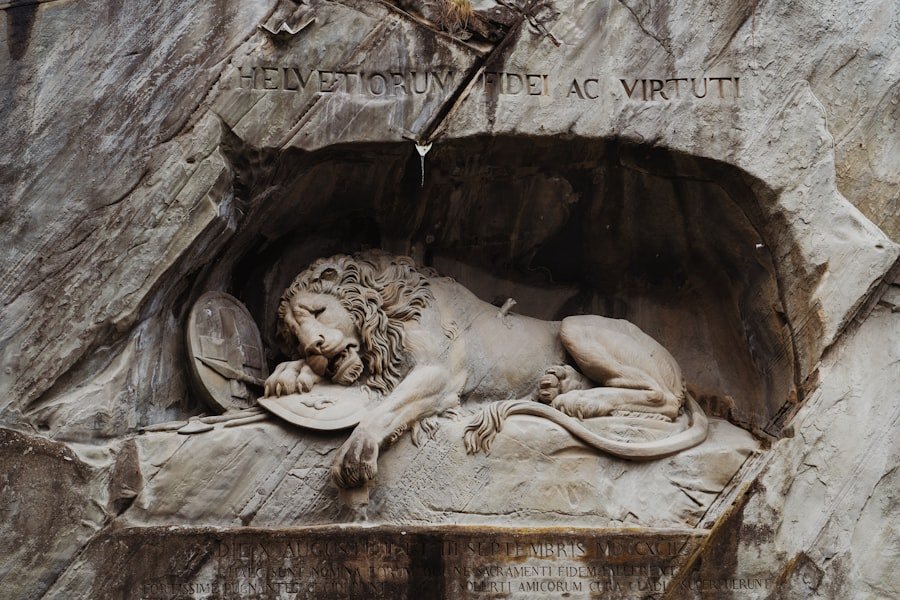
The Lion Monument, also called the Lion of Lucerne or Löwendenkmal, is a large rock relief in Lucerne, Switzerland. It shows a mortally wounded lion resting inside a grotto carved into a former sandstone quarry.
The memorial honors members of the Swiss Guards who served King Louis XVI of France. Many were killed when revolutionary forces attacked the Tuileries Palace on August 10, 1792. Other guards died or were executed during the violence of September 2 and 3.
The sculpture does not present a military victory. Its focus is grief, loyalty, courage, and loss. That emotional approach is one reason many visitors experience the site as a place of reflection rather than only a photo stop.
History and Significance of the Lion Monument
What Happened in Paris in 1792?
Swiss troops had served European rulers for centuries, and a Swiss Guard regiment protected the French royal household during the French Revolution. On August 10, 1792, revolutionary forces stormed the Tuileries Palace while King Louis XVI and his family sought safety with the Legislative Assembly.
Fighting broke out between the attackers and the Swiss Guards. The king ordered the guards to stop fighting, but the confused withdrawal left many exposed. Some died during the battle, while others were captured and killed later.
The monument’s inscription records 26 officers and about 760 soldiers among the dead, along with 16 officers and about 350 soldiers who survived.
These figures are part of the monument’s own inscription and reflect the memorial’s accounting of the events. They should not be read as a simple count of people killed only during the August 10 battle.
How the Memorial Was Created
Karl Pfyffer von Altishofen, a Swiss Guards officer from Lucerne, was home on leave during the attack. He later led the campaign to create a memorial to his former comrades and raised money through public subscriptions.
Danish sculptor Bertel Thorvaldsen accepted the commission and designed the lion. Pfyffer originally wanted a dead lion surrounded by broken weapons, but Thorvaldsen preferred a living, resting animal. The final design became a compromise: a lion that is still alive but clearly dying.
Swiss sculptor Pankraz Eggenschwyler began carving the grotto in 1819. He later fell from the scaffolding, suffered serious injuries, and died. German sculptor Lucas Ahorn took over the project in 1820 and completed the monumental carving in August 1821.
The memorial was formally dedicated on August 10, 1821, the 29th anniversary of the Tuileries attack.
What the Lion, Shields, and Inscription Mean
The wounded lion represents the courage, loyalty, and sacrifice associated with the Swiss Guards. A broken spear remains lodged in its side, showing that the lion has received a fatal wound.
The finished monument includes two shields. The French shield, marked by three lilies, is partly protected beneath the lion. A second shield bears the Swiss cross. Together, they connect the guards’ Swiss identity with their service to the French monarchy.
The Latin words above the grotto, Helvetiorum Fidei ac Virtuti, are commonly translated as “To the loyalty and bravery of the Swiss.” The inscriptions below list officers and give approximate totals for the dead and surviving soldiers.
Note: The monument has always carried political tension. Supporters viewed it as a tribute to courage and fidelity, while democratic critics questioned why Swiss soldiers who served a foreign monarchy should receive a national memorial.
How to Get to the Lion Monument
The Lion Monument is at Denkmalstrasse 4 in Lucerne. From Lucerne railway station, the walk normally takes about 15 minutes. A pleasant route passes Chapel Bridge, parts of the Old Town, and Löwenplatz before reaching the memorial.
You can also take bus 1, 19, or 22 from the railway station to the Luzern, Löwenplatz stop. From the stop, the monument is only a short walk away. Check the current local timetable before traveling because routes can change.
There is no dedicated visitor parking at the adjacent Glacier Garden. Drivers can use nearby facilities such as Löwencenter or City Parking and walk the remaining distance.
Pro Tip: For an easy sightseeing route, start at Lucerne railway station, cross Chapel Bridge, explore the Old Town, continue to the Lion Monument, and then visit the Glacier Garden next door.
What to Expect When Visiting the Lion Monument
Visit at a Glance
| Location | Denkmalstrasse 4, Lucerne, Switzerland |
| Admission | Free |
| Access | Outdoor monument, freely accessible throughout the year |
| Typical Visit Time | 15 to 30 minutes |
| Designer | Bertel Thorvaldsen |
| Carving | Begun by Pankraz Eggenschwyler and completed by Lucas Ahorn |
| Dedicated | August 10, 1821 |
| Approximate Size | 10 metres long and 6 metres high |
| Material | Sandstone cliff face |
When you arrive, you will see the lion carved directly into the cliff above a small pond. Its lowered head, partly closed eyes, broken spear, and relaxed body create a tired and sorrowful expression.
The lion seems partly absorbed into the natural rock, which helps the sculpture feel connected to the old quarry rather than placed in front of it as a separate object.
Ten interpretation panels explain the history and changing meaning of the memorial. The panels contain German and English text. Visitors can access French and Italian versions through a QR code.
The site can become crowded when walking tours and coach groups arrive. Instead of taking one photograph and leaving, allow time to read the inscription, identify both shields, and view the lion from several positions around the pond.
Accessibility at the Lion Monument
Official visitor sources describe accessibility differently. Lucerne Tourism lists the Lion Monument as wheelchair accessible, while Switzerland Tourism classifies the attraction overall as partially accessible.
The monument is viewed from an outdoor park area, but the route you use may include busy pavements, uneven Old Town surfaces, or other obstacles. Visitors who require a specific step-free route should check the latest information with Lucerne Tourism before arriving.
The neighboring Glacier Garden is a separate attraction. Many of its areas have ramps or lifts, but the museum describes the wider site as only partially wheelchair accessible.
Tips for Visiting the Lion Monument
- Visit early for fewer people: Early morning is usually quieter than the middle of the day, especially during the main summer travel season.
- Allow 15 to 30 minutes: This gives you time to study the sculpture, inscription, shields, and interpretation panels.
- Treat it as a memorial: Avoid loud behavior, climbing on barriers, or blocking the main view for a long photo session.
- Wear comfortable shoes: Parts of the walking route through Lucerne’s historic center have uneven surfaces.
- Check the weather: The monument is outdoors, and there is limited shelter immediately around the viewing area.
- Do not depend on one lighting time: Shadows and reflections change with the season, weather, and time of day.
- Protect your belongings: Stay aware of bags, phones, and cameras when tour groups make the viewing area crowded.
Note: Viewing the Lion Monument is free. The Glacier Garden beside it is a ticketed museum and natural-history attraction with its own opening hours.
Nearby Attractions and Activities
The Lion Monument is close to several of Lucerne’s major attractions, making it easy to include in a half-day or full-day walking route.
| Nearby Place | Why Visit | Suggested Time |
| Glacier Garden | Geological formations, museum displays, a rock-world experience, and a mirror maze beside the monument | 1 to 2 hours |
| Chapel Bridge | Historic covered wooden bridge, painted interior panels, and views across the Reuss River | 20 to 40 minutes |
| Old Town Lucerne | Painted facades, historic squares, shops, cafés, and riverside streets | 1 to 2 hours |
| Lake Lucerne | Waterfront walks, scheduled boat trips, and views toward the surrounding mountains | 1 hour or more |
| Musegg Wall | Historic city fortifications and elevated views over Lucerne; tower access may be seasonal | 45 to 90 minutes |
Chapel Bridge, also called Kapellbrücke, is a practical next stop before or after the monument. The bridge crosses the Reuss River near the Old Town and is one of the city’s best-known historic structures.
For a longer day, add a scheduled Lake Lucerne boat trip or a separate mountain excursion to Mount Pilatus or Mount Rigi. Check transport schedules before committing to a mountain trip, because these outings require much more time than the central-city walking route.
Best Time to Visit the Lion Monument
The monument is freely accessible throughout the year, but the visitor experience changes by time of day and season.
Early morning is the best general choice for fewer crowds. Coach tours and larger walking groups are more common later in the morning and during the afternoon.
Spring and autumn can be comfortable for exploring central Lucerne on foot, but rain and sudden temperature changes remain possible. Carry a light waterproof layer rather than relying on a dry forecast.
Summer offers long daylight hours and makes it easier to combine the monument with lake and mountain activities. It is also the busiest period, particularly around midday.
Winter can feel quieter, but the monument remains an outdoor stop. Wear warm footwear and allow extra care on wet, icy, or snowy paths.
Suggested One-Day Lucerne Route With the Lion Monument
If you have one day in Lucerne, include the monument in a central walking route rather than treating it as an isolated attraction.
- Begin at Lucerne railway station and walk toward the lakefront.
- Cross Chapel Bridge and explore the squares and painted buildings of the Old Town.
- Continue through Löwenplatz to the Lion Monument.
- Spend 15 to 30 minutes viewing the sculpture and reading the interpretation panels.
- Visit the Glacier Garden if its geology, museum displays, and mirror maze interest you.
- Walk back toward Lake Lucerne for a café stop, waterfront walk, or scheduled boat trip.
This order limits unnecessary backtracking and balances Lucerne’s history, architecture, public art, and lake scenery.
Conclusion: Is the Lion Monument Worth Visiting?
The Lion Monument is worth visiting because it combines sculpture, landscape, history, and emotion within a compact site. A visit does not take long, but the memorial becomes more meaningful when you understand the events of 1792, examine both shields, and read the inscriptions rather than stopping only for a photograph.
Its location also makes it easy to include in a broader Lucerne itinerary. Pair it with the Glacier Garden, Chapel Bridge, Old Town, and the lakefront for a more complete view of the city.
Approach the site as a memorial as well as a landmark. The lion’s sorrowful expression, the controversial political history, and the names carved below it are central to understanding why the monument has remained so powerful since 1821.
Frequently Asked Questions
What is the Lion Monument?
The Lion Monument is a large sandstone rock relief in Lucerne, Switzerland. It commemorates Swiss Guards who died in Paris during the attack on the Tuileries Palace and later violence in 1792.
How do I get to the Lion Monument?
You can walk from Lucerne railway station in about 15 minutes. You can also take bus 1, 19, or 22 to the Luzern, Löwenplatz stop and walk a short distance to the monument.
What are the opening hours of the Lion Monument?
The monument and the surrounding outdoor park are freely accessible throughout the year. Temporary maintenance, severe weather, or public works may occasionally affect access.
Is there an admission fee for the Lion Monument?
No. Viewing the Lion Monument is free. The neighboring Glacier Garden is a separate museum and natural attraction that charges admission.
Who designed the Lion Monument?
Danish sculptor Bertel Thorvaldsen designed the dying lion. Pankraz Eggenschwyler began work on the rock setting, and Lucas Ahorn completed the monumental carving between 1820 and 1821.
What does the Lion Monument symbolize?
The dying lion represents courage, loyalty, grief, and sacrifice. The French shield beneath the lion and the nearby Swiss shield connect the guards’ Swiss identity with their service to King Louis XVI.
How long do you need at the Lion Monument?
Most visitors spend 15 to 30 minutes at the monument. Allow more time if you plan to read every interpretation panel or visit the Glacier Garden.
Is the Lion Monument wheelchair accessible?
Lucerne Tourism lists the monument as wheelchair accessible, while Switzerland Tourism marks the attraction overall as partially accessible. Visitors who need a specific step-free route should confirm current access details before traveling.
What should I expect when visiting the Lion Monument?
Expect a compact outdoor memorial with a large dying lion carved above a pond. Interpretation panels explain its history, and the viewing area can become crowded when tour groups arrive.
What attractions are near the Lion Monument?
Nearby attractions include the Glacier Garden, Chapel Bridge, Lucerne Old Town, Lake Lucerne, Musegg Wall, churches, museums, cafés, and shopping around Löwenplatz.
Sources
- Lucerne Tourism: Lion Monument — current size, free admission, interpretation panels, transport, walking time, and visitor information
- Switzerland Tourism: Lion Monument Lucerne — year-round access, location, visit duration, accessibility classification, and nearby attractions
- Thorvaldsens Museum Archives: Dying Lion — commission history, symbolism, inscriptions, casualty figures, artists, and political controversy
- Glacier Garden Lucerne: Location and Arrival — current bus routes, walking route, parking guidance, and local access
- Glacier Garden Lucerne: Accessible Travel — current accessibility information for the adjacent attraction