There are airline bankruptcies, and then there is what happened to Spirit Airlines.
Most airlines that go through Chapter 11 do it once. They use the process the way it was meant to be used. Contracts get renegotiated, debt gets reworked, fleets get resized, and the airline comes out smaller but alive. Delta did it. United did it. American did it. Bankruptcy in aviation has usually been brutal, but not final.
Spirit was different.
It filed for bankruptcy protection twice. The first filing in late 2024 was supposed to save the company. The second, in 2025, was the moment everyone had to admit the first one failed. After that, the story was no longer about restructuring. It was about liquidation, aircraft returns, asset sales, and how to stop the remains of the company from burning cash faster than creditors could recover anything.
By the end, Spirit was not just an airline that stopped flying. It was 114 aircraft scattered across 15 airports, tied to lease payments, maintenance obligations, insurance costs, and storage expenses that kept piling up whether those jets flew or not.
That collapse says a lot about Spirit itself, but it also says a lot about the American airline market, the ultra low cost carrier model, antitrust regulation, and why a strategy that transformed Europe never fully worked the same way in the United States.
✈️ Spirit was supposed to change American aviation
To understand why Spirit failed, you first have to understand what it was built to do.
Spirit was the American version of the ultra low cost carrier, or ULCC, model. The idea was simple. Sell the lowest possible base fare, make the headline price irresistible, and then earn the real revenue through add ons.
That meant almost everything outside the seat itself came with a price:
- Checked bags cost extra
- Seat selection cost extra
- Larger carry on bags cost extra
- Even printing a boarding pass at the airport could cost extra
The cheap fare got people in the door. The ancillary fees were where the business really made its money.
That formula had already proven itself in Europe. Ryanair and easyJet had shown that if you strip the product down far enough and keep costs disciplined, you can unlock demand from travelers who otherwise would not fly at all. Spirit and its investors believed the United States was next.
For a while, it looked like they were right.
Spirit expanded aggressively through the 2000s and beyond. It added routes quickly, built a large Airbus narrowbody fleet, and ordered A320neo family aircraft in significant numbers to support continued growth. There were profitable years that appeared to validate the whole strategy. Spirit became one of the most important case studies in American low cost aviation.
It looked like a disruptor with a long runway.
📉 Why the model started breaking down
The ultra low cost model itself is not broken. It works in the right environment. Ryanair still makes it work. Wizz Air makes it work. IndiGo built an aviation giant in India on a version of the same idea.
The problem for Spirit was that the United States was not Europe.
American aviation is heavily dominated by four huge carriers: American, Delta, United, and Southwest. Those airlines control enormous market share, run powerful loyalty programs, have deep corporate travel ties, and operate networks that reach nearly every important city pair in the country.
That matters because Spirit rarely entered an empty market. It usually entered routes where a large incumbent was already entrenched and had tools Spirit could not match.
The most important of those tools was basic economy.
As ultra low cost carriers grew, the major airlines responded by creating fare products designed to compete at the bottom of the market without changing the rest of their brands. Basic economy tickets stripped away many of the same features Spirit had already normalized. Passengers got a low price, limited flexibility, minimal included baggage, and fewer perks.
In other words, the big carriers copied much of the ULCC playbook while keeping everything Spirit lacked:
- Brand trust
- Frequent flyer programs
- Connections across large domestic and global networks
- More schedule depth and recovery options during disruptions
If the cheapest Delta or United fare started to feel close enough to a Spirit fare, a lot of travelers no longer had a strong reason to choose Spirit.
At the same time, Spirit had another problem that was just as serious. Its brand reputation took a beating.
The ULCC model asks passengers to tolerate a lot. Tight seating. A bare bones experience. Fee structures that may be disclosed upfront but still feel punishing during the trip. For travelers who booked only because the fare was low, the experience often left them feeling squeezed at every step.
That matters more than people sometimes admit. A business can survive being cheap. It struggles when cheap starts to feel hostile.
So Spirit got trapped from both directions:
- Legacy airlines eroded its price advantage
- Its own customer experience damaged repeat demand
That was not a temporary rough patch. It was a structural squeeze.
🛫 The JetBlue merger that could have changed everything
In April 2022, Spirit got what looked like an escape route.
JetBlue announced a plan to acquire Spirit for about $3.8 billion. On paper, it was one of the most consequential airline deals in years.
JetBlue brought a stronger brand and a more customer friendly product. Spirit brought scale, aircraft, and routes. Together, the combined airline could have become a meaningful fifth national competitor with enough size to challenge the Big Four more seriously.
For JetBlue, the logic was strategic. It wanted more aircraft and more reach in a market where growth through new deliveries takes time.
For Spirit shareholders, the logic was more existential. The independent path was getting harder. A sale to JetBlue looked increasingly better than trying to keep running a pure ULCC strategy in a market that was turning against it.
For a long stretch, the merger looked real. Shareholders approved it. JetBlue committed to it. The final hurdle was regulatory approval.
That hurdle turned out to be fatal.
⚖️ The DOJ blocked the deal, and Spirit got weaker anyway
In March 2023, the Department of Justice sued to stop the merger.
The argument was straightforward. Spirit, despite its flaws, was one of the strongest low fare forces in the markets it served. If JetBlue absorbed it, those ultra low fares could disappear, and consumers would pay more.
A federal judge agreed and blocked the deal in January 2024. JetBlue walked away.
That decision did not create Spirit’s problems out of nowhere. The weaknesses were already there. The company had been struggling with competition, branding, and economics well before JetBlue entered the picture.
But the failed merger still mattered in a big way.
It consumed time. It consumed management attention. It froze strategic flexibility during a period when Spirit needed a hard reassessment of what kind of airline it could realistically be. By the time the deal officially died, the window for a successful independent turnaround had narrowed sharply.
And then came the irony. The consumer harm regulators said they were trying to prevent eventually arrived anyway, not through consolidation, but through collapse.
💸 The first bankruptcy and why it did not save Spirit
Spirit filed for Chapter 11 bankruptcy protection in November 2024.
This was not a surprise. The signs had been there for months. The hope was that the court process would create enough breathing room to rebuild the airline into something smaller and sustainable.
The plan centered on several familiar restructuring moves:
- Reduce the fleet to a size the business could actually support
- Return leased aircraft
- Cut routes that were not earning their keep
- Renegotiate labor and supplier obligations
- Lower overhead
- Try to repair the brand and soften some of the fee driven pain points
That all made sense on paper. The problem was that bankruptcy can fix a balance sheet more easily than it can fix a market.
The same competitive forces that hurt Spirit before Chapter 11 were still there after Chapter 11:
- The major airlines still had basic economy
- Spirit still had weak customer satisfaction
- The routes were still heavily contested
- Larger competitors still had stronger brands and deeper resources
You can restructure debt in court. You cannot restructure the competitive landscape of U.S. aviation with a court filing.
By the middle of 2025, it was becoming clear that the first bankruptcy had not produced a viable airline. The second filing in August 2025 was effectively the end of the line. This was no longer about saving Spirit. It was about winding it down as cleanly as possible.
🟡 The final flights meant more than the end of a brand
Spirit’s last flights operated over a single weekend in early 2025.
When an airline shuts down, the most visible images are always the same. Empty gates. Last departures. Confused passengers. Nostalgic photos. But those images only scratch the surface.
For employees, the closure meant something much deeper. Pilots, flight attendants, customer service agents, mechanics, ramp workers, and operations staff were not just losing a logo. They were losing jobs, routines, seniority, and in many cases careers built over years.
Airlines tend to create unusually strong internal identity. People do not just work for them. They often tie a piece of themselves to them. That is why airline closures feel more personal than most corporate failures.
For passengers, the impact was immediate and practical. Spirit had been a major low fare presence in places like Fort Lauderdale, Orlando, Las Vegas, and Los Angeles. Once that capacity disappeared, some routes became less competitive almost overnight.
Other airlines would eventually replace part of the capacity. But not instantly, and not always at the same price. In many markets, fares faced upward pressure simply because one of the most aggressive low price players was gone.
That is the uncomfortable lesson here. For all of Spirit’s frustrations, it still acted as a pressure valve on pricing. Even travelers who avoided the airline often benefited from its presence because competitors had to price against it.
🛬 114 aircraft and nowhere to go
Once the flights stop, the real complexity begins.
At the time of shutdown, Spirit still had about 114 Airbus A320 family aircraft spread across 15 U.S. airports. That included various A320 and A321 models, both current engine option and neo variants.
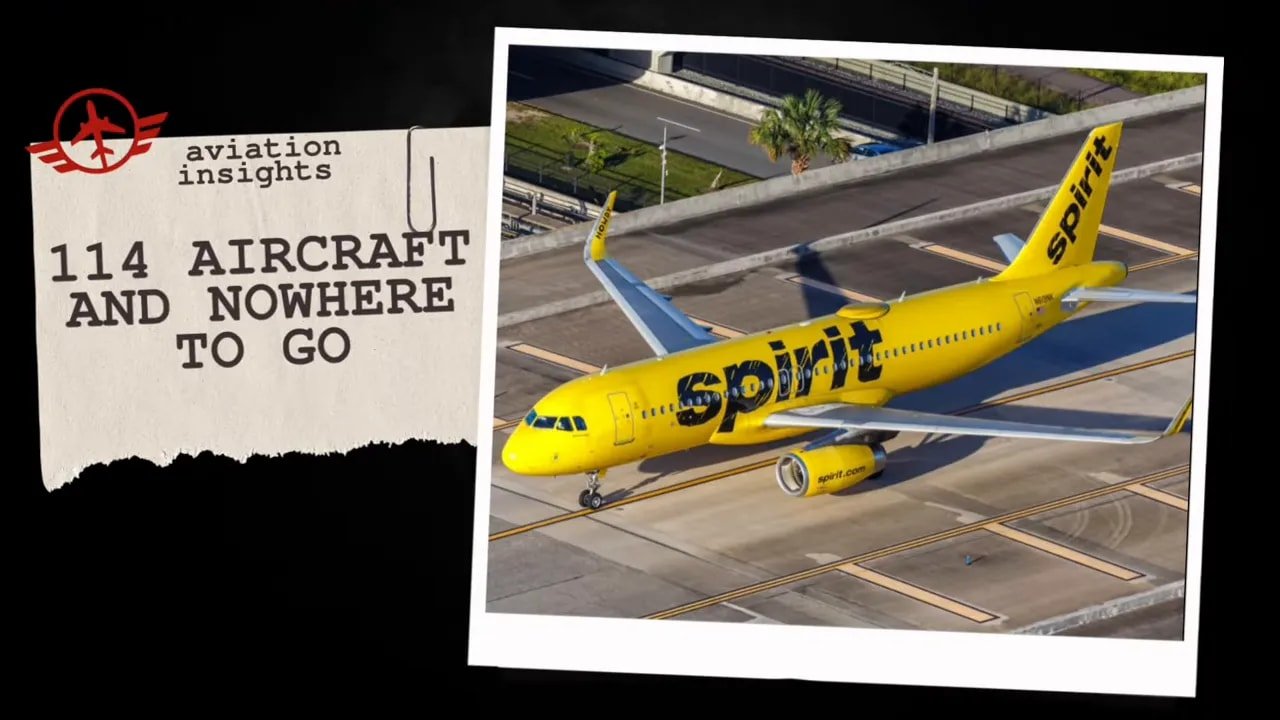
Those aircraft were not all owned outright. In fact, most were leased.
That distinction matters. When an airline leases aircraft, it does not own the jets. It pays monthly rent to lessors that do. Once the airline stops operating and stops making lease payments, the planes still exist, and the bills do too.
Parked aircraft are expensive. They generate:
- Storage costs
- Insurance costs
- Maintenance and preservation requirements
- Return condition disputes with lessors
An airliner cannot simply be left on a ramp forever and ignored. Even inactivity has a maintenance process attached to it, and that process is not cheap.
In bankruptcy, Spirit could reject leases and return the aircraft. But that sounds much simpler than it really is. Each lessor may have different terms, different maintenance expectations, and different ideas about what condition an aircraft must be in when handed back.
Multiply that across dozens of aircraft and many counterparties, and the result is a legal and operational mess.
Spirit also had some aircraft it did own. Those were potential sale assets. A process was reportedly authorized in early 2025 to try to sell up to 20 A320 family aircraft and raise more than $500 million, but the planned auction did not ultimately happen before the airline reached its final end state.
The objective on both the leased and owned side was the same:
- Stop the drain from roughly $300 million in annual lease obligations
- Convert any remaining hard assets into cash for creditors and bondholders
🌍 Why Spirit’s aircraft still matter to the global industry
Here is where the story becomes bigger than one airline.
Spirit’s aircraft are Airbus A320 family narrowbodies, exactly the type the global airline industry badly wants right now. Airbus and Boeing both have huge delivery backlogs. Airlines in many regions are waiting years for new narrowbody jets.
That means relatively young used A320neo family aircraft in decent condition are valuable.
Spirit’s fleet suddenly became relevant to a long list of potential operators:
- Ultra low cost carriers outside the U.S.
- Leisure and charter airlines
- Airlines constrained by delayed new aircraft deliveries
- Operators in Latin America, Southeast Asia, and Africa looking for faster growth options
In other words, the planes did not lose their usefulness because Spirit failed. The demand for narrowbody capacity is still very real. The question is simply who gets those jets, under what terms, and how fast they can be reintroduced elsewhere.
That matters because aircraft supply is now a strategic constraint across aviation. Fleet availability shapes route planning, expansion, pricing power, and competitive balance. Spirit’s collapse dumped a meaningful batch of sought after narrowbodies back into the market at a time when very few airlines can get new ones quickly.
📚 What Spirit’s collapse teaches the entire airline business
Spirit’s shutdown was not just the failure of one controversial airline. It was a stress test of an entire idea.
The idea was that an American ultra low cost carrier could permanently disrupt the market the way Ryanair disrupted Europe. Spirit proved that the idea had real power, but also hard limits.
Here is what the collapse reveals:
- The ULCC model can work, but only if the competitive environment allows enough price separation from larger carriers
- Basic economy gave legacy airlines a powerful defense against low fare disruptors
- Brand damage matters, especially when the product already asks customers to tolerate discomfort
- A merger can look like salvation and still arrive too late
- Regulators can block consolidation to preserve competition, only to watch competition disappear through insolvency instead
- In aviation, fleet obligations can become crushing even after operations stop
Spirit was supposed to be the airline that won by going lower than everyone else. Instead, it discovered that being the cheapest player in a market dominated by giant incumbents is only an advantage until those incumbents decide to follow you down just far enough.
The yellow jets are gone. But the questions Spirit raised are still very much alive:
- Can a pure ultra low cost airline still thrive in the United States?
- Did regulators protect consumers, or just delay a worse outcome?
- Will lower income travelers end up paying more because one deeply imperfect airline disappeared?
Those are not Spirit questions anymore. They are industry questions.
❓FAQ
Why did Spirit Airlines fail?
Spirit failed because its ultra low cost model lost ground in the U.S. market. Legacy airlines copied key parts of the low fare strategy through basic economy, while Spirit continued to struggle with weak customer satisfaction, intense route competition, and a cost structure that became unsustainable.
Did the blocked JetBlue merger cause Spirit’s collapse?
Not by itself. Spirit’s structural problems existed before the merger attempt. But the failed deal used up time, focus, and strategic flexibility during a period when the airline badly needed a clearer turnaround plan.
How many aircraft did Spirit have when it shut down?
Spirit had about 114 Airbus A320 family aircraft remaining, spread across 15 airports. Most were leased rather than owned outright.
What happens to Spirit’s planes after the shutdown?
Leased aircraft are typically returned to lessors through the bankruptcy process, while owned aircraft can be sold to raise cash for creditors. Because narrowbody jets are in high demand globally, many of Spirit’s aircraft are valuable to other airlines.
Did Spirit Airlines’ shutdown make flying more expensive?
In many markets, yes. Spirit was a major low fare competitor, and once it disappeared, capacity dropped on some routes. That reduced competitive pressure and likely pushed fares higher, especially for price sensitive travelers.